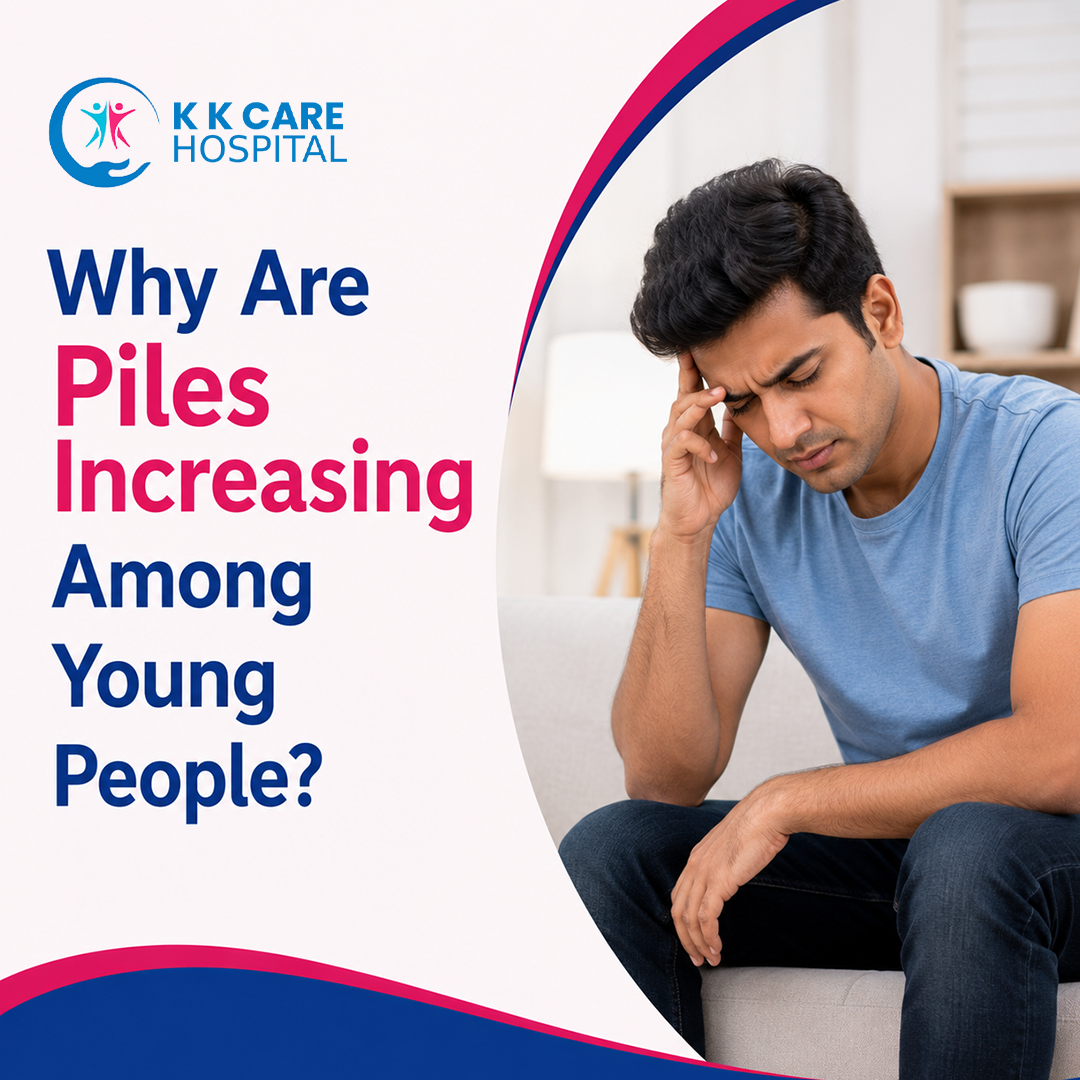
Piles used to be filed under “old age problem.” Not anymore. At KK Care Hospital, our gastro and proctology OPDs are seeing a steady rise in piles in young age, some patients barely in their mid-20s. If you’re dealing with discomfort, bleeding, or itching and wondering “can piles occur in young age?” — the short answer is yes, and it’s more common than you’d think. This article breaks down why hemorrhoids at a young age are climbing, the real lifestyle triggers behind it, how piles are graded, and what you can do before it becomes a bigger problem.
What Are Piles, Exactly?
Piles (hemorrhoids) are swollen veins in the lower rectum or anus. They form when there’s repeated pressure on this area — from straining, prolonged sitting, or constipation. They’re classified as internal (inside the rectum) or external (under the skin around the anus), and both can affect people well before their 40s or 50s, which is when most people still assume the risk begins.
Can Piles Occur in Young Age?
Yes — and increasingly so. Doctors are reporting more piles in young people, particularly those in desk jobs, students preparing for exams, and new parents adjusting to disrupted routines. The condition isn’t tied to age as much as it’s tied to habits, and today’s young adults are picking up habits that speed up the timeline.
What Causes Hemorrhoids in Young Adults?
Here’s what’s actually driving the numbers up:
- Sedentary lifestyles.
Long hours at a desk or in front of a screen reduce blood flow to the pelvic region, increasing pressure on rectal veins.
- Low-fiber, high-processed diets.
Skipping whole grains, fruits, and vegetables in favor of fast food leads to harder stools and constipation — one of the biggest triggers of piles in young adults.
- Chronic constipation from poor water intake.
Many young professionals simply don’t drink enough water through the day, which worsens straining during bowel movements.
- Delaying the urge to go.
Busy schedules mean people hold in bowel movements, which increases pressure over time.
- Excessive gym straining or heavy lifting.
Ironically, some fitness routines — especially heavy weightlifting without proper breathing technique — add strain to the same veins.
- Stress and irregular routines.
Stress disrupts digestion and bowel regularity, indirectly contributing to the problem.
Can You Get Hemorrhoids at a Young Age? Warning Signs to Watch
Yes, and catching it early makes treatment far simpler. Watch for:
- Bleeding during or after bowel movements
- Itching or irritation around the anus
- Pain or discomfort while sitting
- A lump or swelling near the anal opening
- A feeling of incomplete evacuation
These symptoms are often dismissed as “just constipation,” which delays diagnosis and lets the condition progress.
The 4 Grades of Piles (Why Stage Matters)
Piles are graded by severity, and this is what actually determines treatment — not age:
- Grade I: Small internal swelling, no prolapse, occasional bleeding.
- Grade II: Prolapses during bowel movement but returns on its own.
- Grade III: Prolapses and needs to be pushed back manually.
- Grade IV: Permanently prolapsed, cannot be pushed back; often needs surgical treatment.
Most young adults are diagnosed at Grade I or II — precisely when non-surgical treatment works best, which is why early consultation matters more than waiting to “see if it goes away.”
How Piles Are Treated
- Grade I–II: Fiber supplementation, stool softeners, sitz baths, topical medication.
- Grade II–III: Minimally invasive procedures such as rubber band ligation or sclerotherapy, done as day-care procedures.
- Grade III–IV: Surgical options like hemorrhoidectomy or stapled hemorrhoidopexy, recommended when non-surgical methods no longer help.
The right option depends entirely on grade and symptom severity, which is determined during an in-person proctology examination — not a self-assessment.
How to Prevent Piles in Young Age
- Add fiber-rich foods — fruits, vegetables, whole grains — to daily meals
- Drink at least 8–10 glasses of water a day
- Avoid sitting for more than an hour without a short walk
- Don’t delay bathroom visits
- Limit straining during weight training; focus on breathing technique
- Get moving — even 20–30 minutes of daily activity helps regulate digestion
Small, consistent changes to gut health often prevent piles before they need medical treatment — our guide on maintaining gut health and better digestion covers this in more detail, and our high-fiber diet foods list is a good starting point for meal changes.
When Should You See a Doctor?
If symptoms persist beyond a week, involve visible bleeding, or keep recurring despite dietary changes, it’s time to stop self-diagnosing. Early-stage piles are highly treatable with non-surgical methods, but ignoring them can lead to more advanced grades that need surgical intervention. A proper clinical evaluation also rules out other conditions like fissures or fistulas, which share similar symptoms. At KK Care Hospital, our proctology team evaluates each case by grade before recommending a treatment path, rather than defaulting to surgery.
Don’t Wait for Piles to Get Worse
If you’re noticing bleeding, discomfort, or swelling, don’t wait it out hoping it resolves on its own. The Proctology Clinic at KK Care Hospital in Charholi, Pimpri Chinchwad offers confidential, expert evaluation and both non-surgical and surgical treatment options for piles, fissures, and fistulas.
Book a Consultation with Our Proctologist — get an accurate diagnosis and a treatment plan suited to your stage of piles, without the guesswork.
FAQs
Q: Can piles occur in young age?
A: Yes. Sedentary routines, poor diet, and irregular bowel habits mean people in their 20s and 30s are increasingly diagnosed with piles.
Q: What causes hemorrhoids in young adults?
A: The main causes are low-fiber diets, dehydration, prolonged sitting, delayed bowel movements, and pregnancy-related pressure.
Q: Are piles in young people different from piles in older adults?
A: Not in the condition itself — but young patients often ignore symptoms longer due to embarrassment or assuming they’re “too young” for it, which can allow the piles to progress to a more severe grade.
Q: Can piles in young adults be treated without surgery?
A: Yes, in early stages (Grade I–II). Diet changes, medication, and minimally invasive procedures often resolve piles without surgery. Grade III–IV cases may need a surgical approach.
Q: Is bleeding always a sign of piles?
A: Not always — rectal bleeding can also indicate fissures or other conditions, which is why a proper examination matters rather than self-diagnosis.