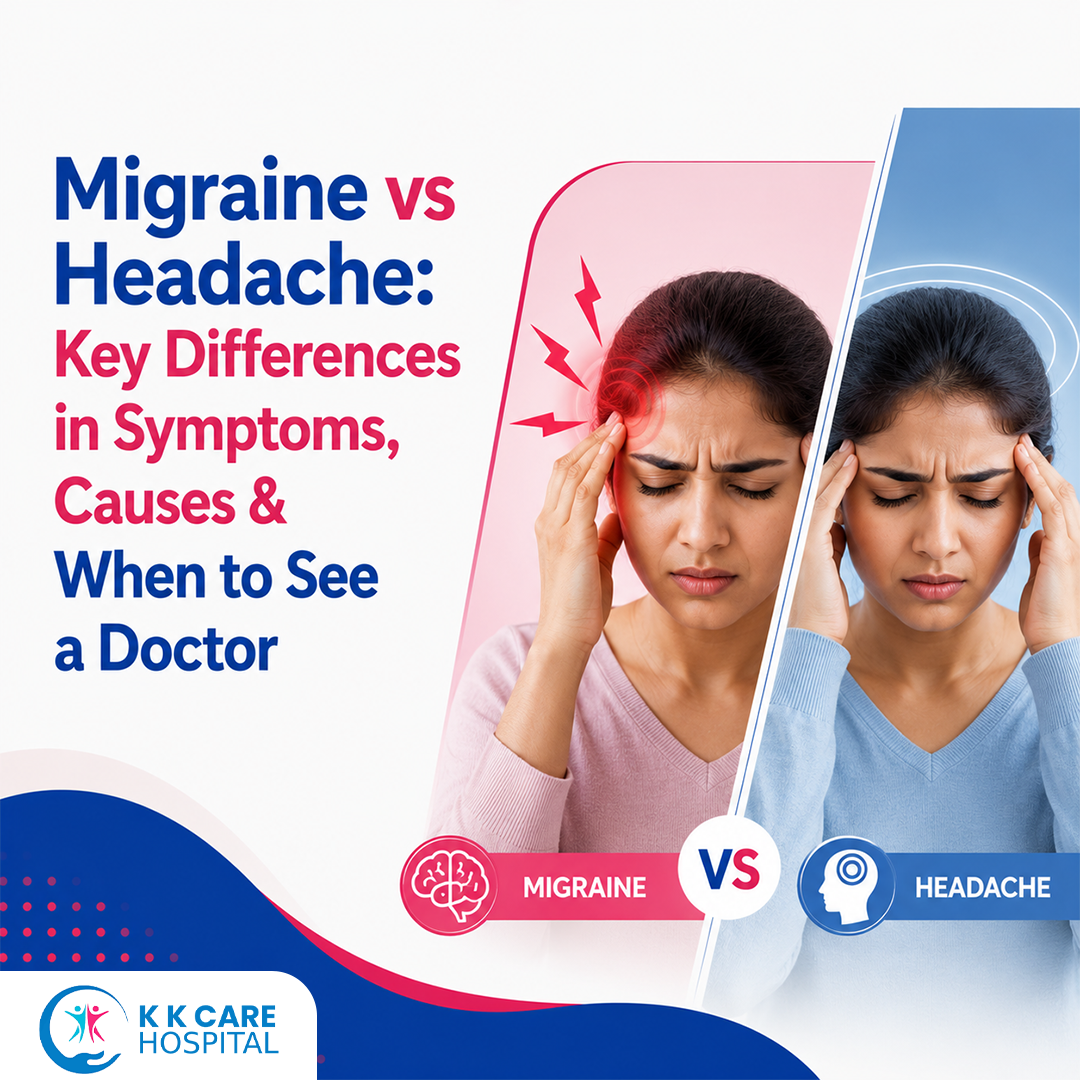
You wake up with your head pounding. Maybe it started mid-afternoon, crept up behind your eyes, and now every light in the room feels like an attack. You reach for a painkiller and wonder — is this just a headache, or is something else going on?
You’re not alone in asking that. The migraine vs headache question is one of the most common things people search before they finally decide to see a doctor. And the truth is, confusing the two can mean years of the wrong treatment, unnecessary suffering, and a condition that quietly gets worse.
At KK Care Hospital, our neurology team in Charholi regularly sees patients who’ve been living with migraines for years — calling them “just bad headaches,” popping over-the-counter pills, and assuming it’s stress. It doesn’t have to be that way.
Here’s what you need to know.
What Actually Is a Headache?
A headache is a symptom, not a disease. It’s your body’s way of signalling something — stress, poor sleep, dehydration, long hours staring at a screen, or sinus congestion. Most headaches are tension-type, and they feel like a tight band squeezing around your head, usually on both sides.
They’re uncomfortable, yes. But they typically ease up within a few hours, respond well to rest and a painkiller, and don’t stop you from getting on with your day.
There are different types — tension, cluster, sinus, and medication-overuse headaches — but the common thread is this: a headache is a signal. Once you address the cause, it goes away.
What Makes a Migraine Different?
A migraine is not “just a really bad headache.” That’s the most important thing to understand.
A migraine is a neurological condition — it involves real changes in brain chemistry and nerve activity. The pain is usually intense, one-sided, and throbbing. But the pain is often not even the worst part.
The symptoms of migraine can include nausea bad enough to make you vomit, sensitivity to light so severe you need to lie in a dark room, sensitivity to sound that makes a normal conversation feel unbearable, and dizziness that makes movement impossible. Some people see flashing lights or experience tingling in their face and hands before the pain even begins — this is called an aura.
A migraine attack can last anywhere from 4 hours to 3 full days. It can completely derail your work, your family life, and your ability to function.
If that sounds familiar, you are not being dramatic. This is a real medical condition — and it’s treatable.
Migraine vs Headache: Side by Side
The difference between headache and migraine becomes clear when you look at them together:
| Feature | Headache | Migraine |
| How it feels | Dull, pressing, like a tight band | Throbbing, pulsating, often intense |
| Where it hurts | Usually both sides of the head | Most often one side |
| How bad it gets | Mild to moderate | Moderate to severe or disabling |
| How long it lasts | 30 minutes to a few hours | 4 hours to 3 days |
| Nausea or vomiting | Rarely | Very common |
| Light and sound sensitivity | Mild, if at all | Severe — often forces you to a dark, quiet room |
| Visual disturbances (aura) | No | Yes, in about 1 in 4 people with migraine |
| Movement | Doesn’t usually make it worse | Walking or climbing stairs can intensify the pain |
The deeper migraine and headache difference is this: a migraine follows a pattern. It can be triggered, predicted, and — with the right care — prevented.
The Phases of a Migraine Attack
One of the clearest signs that what you’re experiencing is a migraine is that it happens in stages. Recognising these symptoms of migraine early can help you manage an attack before it peaks.
Phase 1 — Prodrome (a day or two before): You might feel unusually tired, irritable, or have food cravings. Some people yawn excessively or notice neck stiffness. This is your brain giving you a warning.
Phase 2 — Aura (30 to 60 minutes before, not always present): Zigzag lines or flashing lights in your vision, temporary blind spots, tingling on one side of your face or hand, or difficulty finding words.
Phase 3 — The attack itself: The pain arrives — throbbing, often one-sided, worsened by movement. Nausea, vomiting, and extreme sensitivity to light and sound make this phase genuinely debilitating for many people.
Phase 4 — Postdrome (the “migraine hangover”): The pain fades but you feel exhausted, foggy, and drained for up to 24 hours afterwards.
If this cycle sounds like something you’ve lived through — possibly without knowing what to call it — it’s time to get properly assessed.
What Triggers a Migraine?
Unlike a tension headache (which is usually caused by something obvious like stress or dehydration), migraines have triggers that vary from person to person. Common ones include:
- Hormonal changes — many women notice migraines are tied to their menstrual cycle
- Skipping meals or irregular sleep patterns
- Certain foods and drinks — red wine, aged cheese, caffeine, MSG
- Bright or flickering lights, strong perfumes, or loud environments
- Emotional stress or sudden relief of stress (the “let-down migraine” that hits on weekends)
- Weather changes or high humidity
One of the most useful things you can do — even before your first doctor’s appointment — is start a simple diary. Note when the attack happened, how long it lasted, what you ate, how you slept, and any other patterns. This gives your neurologist exactly what they need to build an effective plan.
Headache vs Migraine: When Should You Actually See a Doctor?
For headaches, most people can manage at home. But do seek help if your headache is sudden and severe — especially if it’s the worst pain you’ve ever felt in your life. That kind of headache needs emergency evaluation. Same if it comes with a stiff neck, fever, confusion, or follows a head injury.
For migraines, you shouldn’t have to keep suffering in silence. See a general physician or neurologist if:
- You’re getting headaches 4 or more times a month
- The pain regularly lasts longer than 24 hours
- Painkillers aren’t working like they used to
- Your symptoms are affecting your work, sleep, or relationships
- You’re experiencing aura for the first time, or your aura is changing
Our Neurology & Neurosurgery specialists at KK Care Hospital don’t just treat the pain — they work to understand your personal pattern, identify triggers, and create a long-term plan so you have fewer attacks, not just a prescription to push through them.
What Treatment Actually Looks Like
For tension headaches: Rest, hydration, a painkiller if needed, addressing posture or screen habits. Usually that’s enough.
For migraines, it’s more personalised:
For attacks that have already started, medications called triptans work specifically on migraine pathways in the brain — much more effectively than standard painkillers for most people.
For people with frequent migraines (more than 4 a month), preventive therapy matters more than just treating each attack. This can include certain blood pressure medications, low-dose antidepressants, or newer CGRP inhibitor injections that have transformed care for many chronic migraine patients.
For severe, chronic migraine (15 or more headache days per month), Botox injections administered by a neurologist can significantly reduce attack frequency.
And for many people, non-medication approaches — identifying and avoiding triggers, improving sleep consistency, stress management — make a meaningful difference alongside any medical treatment.
One important warning: taking painkillers more than 10–15 days a month for headaches can actually cause “medication overuse headache,” making the problem worse. This is exactly why the right diagnosis matters.
You Deserve More Than Just “Take a Painkiller and Rest”
If you’ve been managing recurring headaches on your own — quietly, because you assumed it was just stress or that nothing could really be done — please know that effective treatment exists. Migraine is one of the most undertreated neurological conditions in the world, partly because people don’t realise how much better life can be with the right care.
At KK Care Hospital, our Neurology & Neurosurgery team has helped patients in Charholi, Moshi, Alandi, and across Pimpri-Chinchwad move from weekly migraine attacks to months of relief. We also offer dedicated support through our Pain & Palliative Medicine clinic for complex or long-standing cases.
You don’t have to keep guessing. A proper diagnosis takes less time than another migraine.
Frequently Asked Questions
Q1. What is the main difference between migraine and headache?
A: A headache is a symptom — head pain typically caused by stress, tension, or dehydration, that resolves on its own. A migraine is a neurological condition with distinct phases, associated symptoms like nausea and light sensitivity, and attacks that can last days. The difference between migraine and headache goes well beyond pain intensity.
Q2. Can a migraine happen without any head pain?
A: Yes, and this surprises many people. “Silent migraines” — also called acephalgic migraines — involve the aura phase (visual disturbances, tingling, nausea) without the headache itself. They still need evaluation and management.
Q3. How do I know if what I have is actually a migraine?
A: Ask yourself: does the pain throb? Is it usually on one side? Does it last longer than 4 hours? Do you feel sick, or need to hide from light and sound? If yes to most of these, there’s a strong likelihood it’s migraine. A neurologist can confirm with a proper assessment.
Q4. Do migraines run in families?
A: Yes. Migraine has a strong genetic component. If one parent has migraines, there’s roughly a 50% chance a child will develop them. If both parents do, that rises to about 75%.
Q5. When is a headache a medical emergency?
A: Go to the emergency department immediately if your headache is sudden and explosive (like a “thunderclap”), if it comes with a stiff neck, high fever, confusion, vision loss, or weakness on one side of the body, or if it follows a head injury. These can indicate meningitis, a brain bleed, or stroke.